When comparing DR Horton homes Omaha buyers have a lot more to consider than a floor plan and a price tag. You need to compare the whole package: location, lot, construction timeline, included features, financing options, HOA rules, warranties, and what it will cost to maintain the home after closing.
The big takeaway is simple: do not automatically rule out new construction, and do not automatically assume it is perfect either. Get out there, look at the homes, compare them against existing options at the same payment range, and make the decision based on what actually works for your life.
Where DR Horton Homes Omaha Are Built
DR Horton is the largest homebuilder in the United States by volume, and the Omaha operation has been growing following the purchase of Celebrity Homes lots and land. The local product line includes single-family houses, townhomes, villas, twin homes, and some slab home options.
For people researching DR Horton homes Omaha, the key thing is that the company is not building in just one corner of town. Communities have been concentrated in northwest Omaha, southwest Omaha, Papillion, Bellevue, Bennington, and nearby areas. Expansion toward Blair and Lincoln was also being planned.
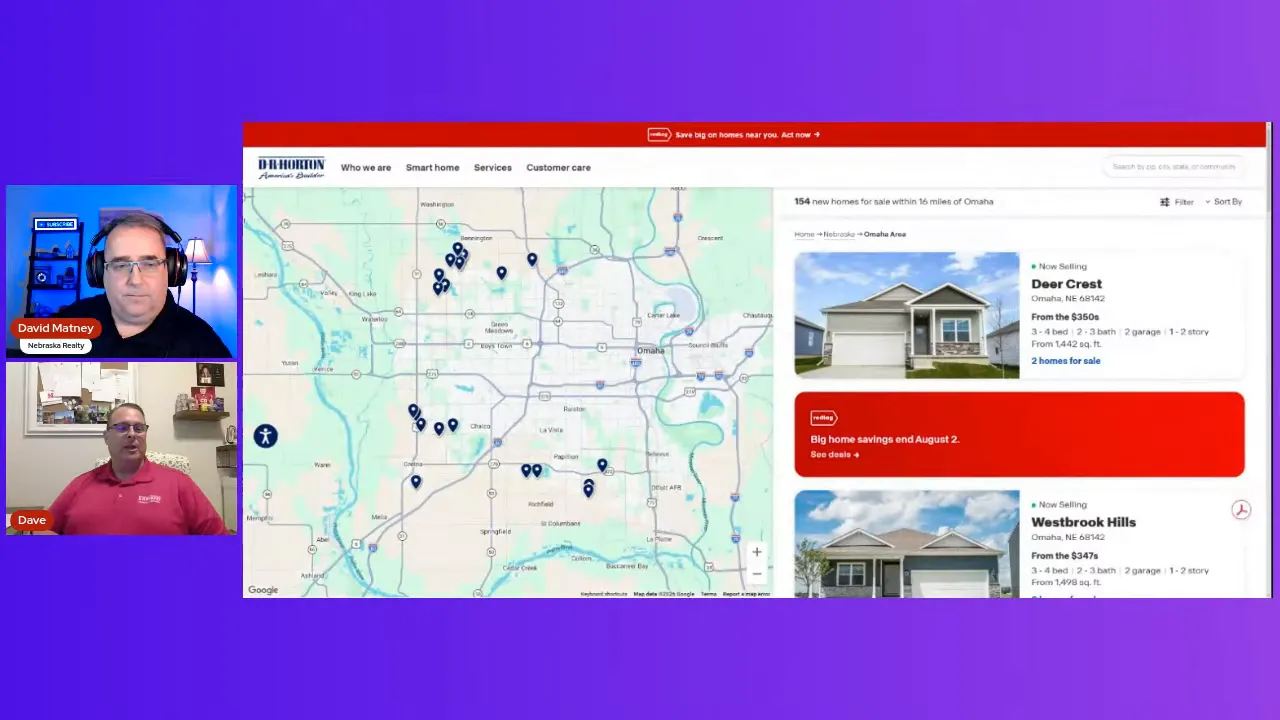
That broad footprint matters because the right community is not always the one you first had in mind. A buyer may be set on southwest Omaha, then discover that Bennington adds only a couple of minutes to a commute while opening up a better lot, home, price, or incentive.
Do not get tunnel vision. Start with the commute, schools, lifestyle, and the areas that make sense, but keep the search radius wide enough to uncover better options.
New Construction Versus Existing Homes
There is always somebody online saying, “They do not build them like they used to.” Well, thank goodness for that in a lot of cases. Older homes can be wonderful, but old homes also come with old-home maintenance issues.
A home built decades ago may have items such as cinder block foundations, older sewer lines made from clay sections, old electrical panels, screw-in fuses, knob-and-tube wiring, single-pane windows, or drainage systems that do not meet modern expectations. Older sewer lines and mature trees can also create a recipe for root intrusion.
New construction homes in Omaha generally bring newer materials and systems into the equation. That can include PVC sewer lines, modern electrical systems, double-pane windows, drain tile, sump systems, and passive radon mitigation. A new roof, new mechanical systems, and new appliances also mean fewer immediate age-related replacement concerns.
That does not mean a new home needs no maintenance. Every home requires attention. Soil settles, caulk needs maintenance, landscaping takes work, gutters need to drain correctly, and sod needs water. The difference is that a new home typically begins with new systems and warranty coverage, rather than a long list of components already approaching the end of their useful life.
The fair way to compare DR Horton homes Omaha options is to compare the entire ownership picture:
- Purchase price and monthly payment
- Expected maintenance and near-term repairs
- Energy efficiency and insurance costs
- Warranty coverage
- Location, commute, and neighborhood rules
- What is included versus what must be added later
Also be careful with flips. A remodeled house may look good on the surface, but it is fair to ask who completed the work, whether permits were pulled when needed, and what was actually replaced behind the walls.
Home Types Price Ranges And Options
One strength of DR Horton homes Omaha is the variety of home types. At the time discussed, townhomes started around the mid-$275,000 range. At the upper end, larger homes such as the Fairfield could reach roughly the mid-$500,000 range, offering about 3,000 square feet with four bedrooms and four bathrooms.
That is a broad range. There are entry-level options, larger finished-basement homes, ranches, two-story plans, villas, townhomes, and twin homes. Several floor plans were already available locally, with additional former Celebrity plans expected to be adapted for the DR Horton lineup.
The planned returning designs included the Morada, Vista, and Jordan. The Vista was described as a multi-level plan around 1,600 square feet, while the Jordan was a ranch around 1,300 square feet. Floor plans can change over time, so always confirm the current availability, options, and pricing before making a decision.
Do not assume every house is exactly the same. Buyers selecting a lot and building from the ground up may be able to choose the floor plan, exterior elevation, color package, and other selections. Individual plans may offer multiple exterior elevations, with differences in rooflines and front porch options.
Some communities use cement board siding, including Hardie Board, rather than older hardboard products. The local discussion also highlighted six-inch gutters and hinged downspout extensions. That may sound like a small thing, but drainage is not a small thing. Keeping water moving away from the foundation matters.
Villas And Zero Entry Options
Villas are a good fit for buyers who want the feel of a single-family home with less exterior upkeep. In the Bellevue villa example discussed, a monthly HOA fee covered mowing, snow removal, and trash service. Fencing was allowed within the community rules, using black wrought iron fencing.
Some Hamilton slab homes were being built with zero-entry access. That can be a major consideration for buyers planning ahead for mobility, downsizing, or simply avoiding basement stairs. Three-car garages may also be available on many home types, although not in every neighborhood or plan.
Financing Incentives And Deposits
Financing can change the conversation quickly. When evaluating DR Horton homes Omaha, look beyond the sticker price and compare monthly payments, rate incentives, lender costs, closing-cost assistance, insurance, and timing.
At the time of the discussion, qualifying buyers using DHI Mortgage could receive $3,000 toward closing costs. Eligible law enforcement professionals, firefighters, healthcare professionals, and educators could receive an additional $1,000 through the Hometown Heroes program. Incentive terms, loan products, rates, deadlines, and qualification rules can change, so verify all current details directly with the lender and builder.
There was also an example of temporary rate incentives that could increase purchasing power substantially. A buyer approved around $375,000 might potentially have the payment capacity for a home closer to $425,000 depending on the rate incentive. A lower interest rate can make a major difference, especially for buyers near their maximum comfortable payment.
You can use your own lender. The point is not that one lender must be used. The point is to compare. If the builder-affiliated lender offers stronger incentives, lower pricing, or better insurance options, that may be the better deal. If an outside lender beats it, great. The buyer should choose what is best for the buyer.
For DR Horton homes Omaha, deposits were described as $1,000 for many homes, with $2,500 required when selecting a lot and choosing the home to be built there. The higher deposit reflects the additional selections involved in a build-from-scratch purchase.
Move-In Ready Homes And Rate-Lock Risk
Not everybody wants to wait nine months for a home. One advantage of a production builder is that there may be homes already under construction and nearing completion. In the discussion, there were commonly 20 to 40 homes projected to be ready within about 30 days.
That can help a buyer avoid some of the uncertainty that comes with a long construction timeline. On a home that will not close for many months, the final mortgage rate might not be locked until roughly 45 days before closing. Interest rates can move a lot in nine months. A quicker closing timeline can make planning easier.
Inspections Warranties And Home Orientation
A new home is still a major purchase. Get a third-party inspection if you want one. For DR Horton homes Omaha, inspectors can generally inspect at different construction stages as long as access is coordinated in advance. The process discussed required about one week of notice, with the final inspection completed at least seven days before the homeowner orientation.
That timing is a big deal. It gives the builder time to address inspection items and punch-list issues before the orientation. Then the buyer can return for the walkthrough and confirm that the identified items have been corrected.
The homeowner orientation is not a formality. Pay attention. The superintendent explains how the house operates, points out maintenance items, and helps the owner understand systems such as the sump pump, HVAC equipment, shutoffs, smart-home components, and drainage features.
Warranty coverage described in the discussion included:
- A one-year limited warranty covering interior items and many new-home concerns
- Direct access to the neighborhood supervisor during the first 30 days
- Warranty requests submitted through the builder website after the initial period
- Drywall repairs for typical settlement cracking
- Potential backfill work if soil settlement exceeded six inches
- A 10-year structural warranty
- Manufacturer warranties on many mechanical and installed components
Concrete has its own realities. Concrete is gray, concrete can crack, and buyers should note any concerns during the applicable walkthrough process. Also understand exclusions. Sod was specifically discussed as not being warranted. Newly installed sod needs serious watering, and it is easy to underestimate how much water it takes to establish it.
Smart Home And Radon Features
Many DR Horton homes Omaha purchases include smart-home technology. The package described included a video doorbell, smart panel, programmable thermostat, smart front-door lock, and an Alarm.com app, with three years of service included at that time. Optional smart switches, timers, dimmers, and motion-responsive features could also be added.
Nebraska buyers should also understand radon. Radon is a colorless, odorless radioactive gas that comes from soil. The homes discussed included a passive radon system with a sealed sump and PVC vent pipe. The system could be converted to active mitigation later if needed by adding a fan.
Lots Basements And Site Selection
Here is one of the biggest mistakes buyers make: choosing a plan without physically walking the lot. Two lots are not created equal. A corner lot, backyard exposure, drainage pattern, neighboring homes, utility placement, slope, and street traffic can all change how a home feels.
Before finalizing a DR Horton homes Omaha contract, walk the lot with your real estate agent and the builder representative. Do not just look at a plat map and assume it will be fine.
Lot type matters especially when basements are involved:
- Walkout lot: The ground slopes down enough for a basement door leading to a patio, often with a deck above.
- Daylight lot: The basement has windows with more natural light and exterior visibility, but usually no exterior basement door.
- Flat lot: The basement windows are lower in relation to grade, though egress windows and ladders provide an exit route.
Many new homes include egress windows where older houses might not. That is an important safety feature. New construction can also include efforts to manage disturbed soil around the home. Soil settlement is normal after construction, but grading, downspouts, gutters, and drainage should all be part of the conversation.
Out Of State Buyers And Omaha Commutes
People relocating to Omaha often worry about commutes, and rightly so. The good news is that many metro communities are within a reasonable drive of downtown. A 20-minute commute can be possible from several areas, but Bellevue and Bennington are obviously very different locations, so do not treat Omaha as one small dot on a map.
For out-of-state buyers considering DR Horton homes Omaha, begin with the job location and daily routine. Then compare travel times during the hours you actually expect to commute. Sometimes the area that looks farther away on a map only adds a few minutes and gives you a better home choice.
Remote purchases can be managed with video calls, recorded orientations, virtual walkthroughs, and detailed punch-list updates. Still, if you can visit the lot and the community in person before finalizing your choice, do it. Lot selection is too important to treat casually.
Finally, bring your real estate agent when you visit a model home. Having the builder representative, buyer, and agent working from the same information helps everyone. An agent can compare new homes in Omaha with resale options, evaluate the lot, help review timing, and keep the overall purchase strategy focused on your needs.
Frequently Asked Questions
Are DR Horton Homes Omaha A Good Alternative To Existing Homes?
They can be, especially when comparing total ownership costs. New construction may offer new systems, modern drainage features, warranties, energy-efficient windows, and fewer immediate age-related repairs. The right answer depends on price, location, lot, payment, and what is available in the resale market.
Can I Use My Own Lender For A DR Horton Home?
Yes. Buyers can use their own lender, but it is smart to compare that offer with DHI Mortgage. Builder-affiliated financing may include closing-cost assistance, rate incentives, or insurance pricing that changes the overall deal.
Can I Hire A Third Party Inspector For New Construction?
Yes. Third-party inspections can generally be arranged during construction stages with advance coordination. The discussed process required about one week of notice and completion before the homeowner orientation.
What Does The HOA Usually Cover?
It depends on the community. Annual HOA dues in many neighborhoods were described as roughly $175 to $225 per year, often supporting neighborhood entrances or common fencing. Villa communities may have monthly dues that include services such as mowing, snow removal, and trash.
What Is The Most Important Step When Choosing A New Construction Lot?
Walk it in person. Confirm the location, slope, backyard exposure, neighboring homes, drainage, and street setting before committing. The house plan matters, but the lot can make or break the experience.
Do New Homes Still Need Maintenance?
Absolutely. New homes still need gutter checks, drainage attention, lawn watering, seasonal maintenance, and care for mechanical systems. New construction reduces some age-related risks, but it does not remove the responsibility of homeownership.