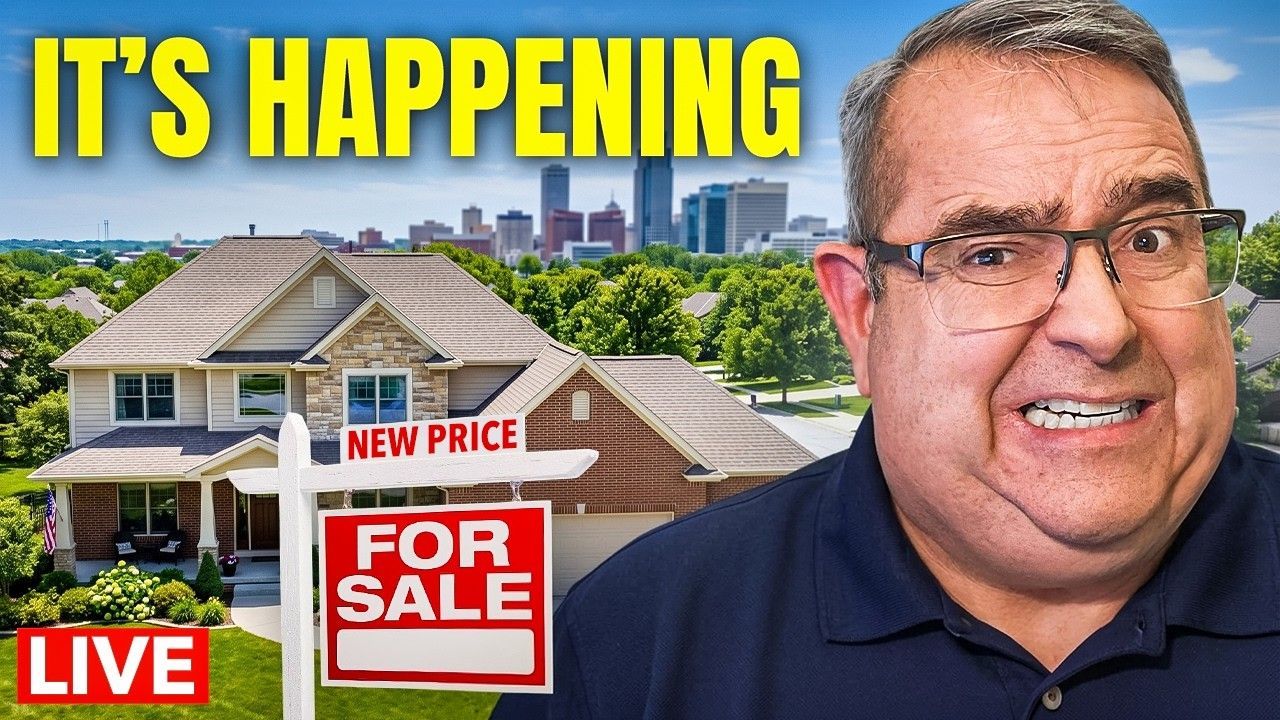
Is 2026 the WORST Time to Buy a Home in Omaha?
Standing in a model home in southwest Sarpy County on a January evening, you can feel the tension in the air. Mortgage rates sit above 7%. Home prices in Douglas and Sarpy County hit $330,000 last month, up from September 2025. Property taxes and insurance keep climbing. And yet the cranes are everywhere, Avenue 1, the airport expansion, the convention center, Heartwood Preserve. Builders like D.R. Horton and Lennar are pouring money into Omaha, which tells you something about this market that the national headlines miss.
So is 2026 one of the worst times to buy a home in Omaha? The answer depends on what you compare it to and what you need right now. This isn't 2021, when buyers paid $20,000 to $40,000 over asking and made five or six offers before one stuck. But it's also not a market where you can wait for rates to drop to 3% and prices to fall 30%. That's not how Omaha works. Let's look at both sides, the real costs, the real advantages, and when buying actually makes sense.
Table of Contents
- Why Buying Feels So Hard Right Now
- What Mortgage Rates Above 7% Actually Do to Your Buying Power
- Home Prices in Omaha: Still Rising, Not Falling
- Sales Volume Is Tanking, And What That Means for Buyers
- The Advantages of Buying in 2026: Less Competition, More Negotiating Room
- Builder Incentives: How D.R. Horton and Others Are Offering Sub-5% Rates
- Why Waiting for Lower Rates Can Backfire
- When It Makes Sense to Wait
- Which Buyers Have the Edge Right Now
Why Buying Feels So Hard Right Now
Buying a home in 2026 is not easy. Mortgage rates are well above 7%, home prices are still elevated, insurance costs continue to rise, and property taxes in Omaha are climbing. You're paying more money to buy less home than you could have afforded two years ago. That's the reality.
But here's the thing: higher mortgage rates don't just hurt buyers trying to get into the market. They also lock existing homeowners in place. If you bought a home in 2020 or 2021 with a 3% interest rate, why would you sell and move up to a 7.5% rate? You wouldn't, unless life forces your hand, marriage, divorce, a new baby, a death in the family. Those life events always create a market, but the discretionary movers are sitting this one out.
According to Mortgage News Daily, the 30-year fixed-rate mortgage is at 7.48%. To understand what that does to affordability, consider this: if you had a $350,000 loan at 6%, your payment would be a certain amount. If rates went up to 7.5% and you wanted to maintain that same payment, you could only afford a $300,000 loan. But prices didn't go down. So you're stuck paying more for less.
Higher rates also push the median age of homebuyers up. Last year the National Association of Realtors reported that the median age of a first-time buyer hit an all-time high. Younger buyers are getting priced out. The 2026 profile hasn't been released yet, but I expect that number to climb even higher. Everything is so unaffordable that people are waiting longer to buy.
What Mortgage Rates Above 7% Actually Do to Your Buying Power
Let's put some numbers to this. If you look at the 30-year fixed-rate mortgage going back to the early 1970s, data from the St. Louis Federal Reserve, you'll see that rates have been all over the place. We had rates above 18% in the early 1980s. We had rates in the 4s and 3s after the Great Financial Crisis. Right after the pandemic, rates dropped to historic lows, which drove massive demand and sent prices soaring.
Now we're back above 7%, and people are shocked. If you talk to someone who bought a home in the 1980s, they'll tell you they paid 9% or higher. But if you talk to younger buyers who came of age after the Great Financial Crisis, they got used to rates in the 5s, 4s, and 3s. Everybody got spoiled. Then came the shock after the pandemic when the Federal Reserve started raising rates to fight inflation.
Here's the relationship that matters: the 30-year fixed-rate mortgage tracks the 10-year Treasury yield. When the bond market moves, mortgage rates follow. A lot of people think the Federal Reserve directly controls mortgage rates by raising or lowering the federal funds rate. That's not how it works. The Fed funds rate affects short-term borrowing. Mortgage rates are tied to the bond market, which is driven by inflation expectations, economic growth, and investor sentiment.
So when people say, "I'll just wait for the Fed to lower rates," they're missing the point. The Fed can lower the federal funds rate, but if inflation is still running hot or if bond investors are worried about deficits and government spending, mortgage rates can stay elevated or even go up. That's what we're seeing now. Inflation is running hotter than expected, and mortgage rates are not cooperating.
Home Prices in Omaha: Still Rising, Not Falling
In Douglas and Sarpy County, the median closed sales price last month was $330,000. That's actually up from September 2025. Prices are not falling. They're still going up.
Now, if you stretch this out over a five-year timeframe, you see some seasonal fluctuation. Prices tend to peak in the summer months because more buyers are active and more homes close during the summer. Families want to move before the school year starts. That's why you see this seasonal pattern every year.
To smooth out seasonality, I look at a rolling 12-month average. Back in January 2021, the median closed sales price in Omaha was $235,000. Today, using a rolling 12-month average, it's $338,878. That's a massive increase in just five years.
Nationally, the median closed sales price in the second quarter was $410,700 according to the St. Louis Federal Reserve. Omaha is still more affordable than the national median, but we're not immune to the same pressures. Prices are elevated, and they're not coming back down anytime soon.
Why? Because we didn't build enough homes coming out of the Great Financial Crisis. Builders got burned in 2008 and 2009. They laid people off and stopped building. Look at the data on new privately owned housing units completed, single-family homes. Builders do not want to lose money. When the market crashes, they pull back hard. They don't want vacant homes sitting on their books.
So from 2010 through 2019, we underbuilt. Then the pandemic hit, demand spiked, and we had a supply shortage. Prices went up. Now we have higher rates, but we still don't have enough inventory. That's why prices are sticky.
Sales Volume Is Tanking, And What That Means for Buyers
Let's look at the number of closed sales in Douglas and Sarpy County. If you look at the monthly data, you see the same seasonal pattern: sales peak in June and July, then drop off in the winter. January is one of the slowest months because of December closings and the holidays.
In July 2021, we had 1,500 closed sales. This past June, we had 1,200. Last month, we had 803. But when you smooth it out with a 12-month rolling average, the trend is clear: sales are tanking. We had a spike right after the pandemic when rates were low and everybody and their cousin was buying a home. We went from under 4 million home sales nationally to over 6 million. Then rates went up, and sales dropped back down to around 4 million.
That same pattern is playing out in Omaha. Sales volume is falling because fewer people can afford to buy, and fewer existing homeowners are willing to sell and give up their low rates.
But here's what that means for buyers: less competition. If you're a buyer in 2026, you're not competing with five or six other offers on every property. You're not paying $30,000 over asking just to get in the door. You have time to do inspections. You can ask for concessions. You can negotiate.
The Advantages of Buying in 2026: Less Competition, More Negotiating Room
So what are the advantages of buying a home now? There's less competition for buyers. During the pandemic market, I had clients who made five or six offers before they got one accepted. They had to waive inspections, waive appraisals, and pay tens of thousands over list price. If you were a buyer back then, that market sucked.
Now? You can take your time. You can look at stuff that's fresh to the market. You can do inspections. You can ask the seller to pay some of your closing costs, which is called a seller concession. Even if a home sells for full list price, you can ask the seller to contribute toward your closing costs or buy down your interest rate.
Some buyers are sitting on the sideline waiting for rates to decline. That means fewer competing offers, especially on properties that have been on the market for a while. This time of year, late fall and winter, sellers get nervous. They're not getting showings. They start to realize they might have overpriced the home.
I see this in our office all the time. Sellers say, "Can't we just try it at a higher price?" And you can, but if you overprice a property, you're going to sit. If you have a home that's worth $300,000 and you price it at $325,000, and a buyer can go out and buy a brand-new home from D.R. Horton with builder incentives and a lower rate, why would they buy your outdated home with deferred maintenance? They wouldn't.
Sellers live in a bubble sometimes. You show them the data, you show them the comps, and they still don't get it. I had a seller during the Great Financial Crisis who listed at $225,000 and got an offer for $200,000. They turned it down. Two years later, after going through eight other agents, I was agent number nine. We finally sold it for $135,000. They should have taken that first offer.
The market can be brutal, and if you overprice a home, you're going to lose. But as a buyer, that's your opportunity. You can negotiate. You can ask for concessions. You can walk away if the numbers don't work.
Builder Incentives: How D.R. Horton and Others Are Offering Sub-5% Rates
Here's something a lot of people don't know: some builders are offering special financing incentives. D.R. Horton has their own mortgage company, and I had buyers recently who were able to purchase a brand-new home and get a 4.9% interest rate. The actual APR was a bit higher, but they had a special financing deal.
Now, this isn't on all of their homes. It's on select inventory. But when you have that kind of incentive, it gives you more buying power. Somebody buying a $350,000 home at 4.9% might have a lower monthly payment than somebody buying a $300,000 home at 7.5%. That's a huge advantage.
D.R. Horton is a publicly traded company. They're smart. They know where there's opportunity. The fact that they're coming into Omaha and building like crazy tells you something about this market. Same with Lennar, who's also coming into town. These builders don't throw money at markets that are about to collapse. They're looking at the fundamentals: job growth, population growth, infrastructure investment, and demand.
We're expanding the airport. We've got Avenue 1 coming in. We're expanding the convention center. We're building a streetcar. We've got Heartwood Preserve being developed in southwest Sarpy County. There are cranes all over this town. Drive down any major road and you'll see new construction going up.
Now, here's the catch with builder incentives: your agent has to be with you on your first visit to the model. If you go alone and then bring your agent later, the builder won't pay your agent's commission, and you might lose access to those incentives. So if you're thinking about new construction, bring your agent from day one.
Also, builder-grade quality is what it is. It's a mass-produced product. They use the same doors, the same countertops, the same finishes in every home. It's not custom. But if you can get a lower rate and a lower monthly payment, that might be worth the trade-off.
Why Waiting for Lower Rates Can Backfire
A lot of people are waiting for rates to come back down. But here's the thing: what if they don't?
Look at the 30-year fixed-rate mortgage going back to the early 1970s. In 1973, rates were around 7%. Let's say you decided to wait for rates to come back down. Well, rates didn't come back down. They went up. We had the OPEC oil embargo, we had inflation, and rates kept climbing. By the early 1980s, rates were above 18%.
If you waited from 1973 for rates to come back down to where they were, you would have waited until 1993, 20 years, before rates came back down.
Now, I'm not saying rates are going to 18%. But I am saying that waiting for rates to drop to 3% or 4% might mean waiting a very long time. And while you wait, what happens to prices? They keep going up.
Even during the early 1980s, when Paul Volcker jacked up the federal funds rate and we had a major recession, home prices still went up. Why? Because we had demand. The baby boomers were turning 30 years old. They were getting married and buying homes. We had population growth. Demographics drove demand, and prices kept rising even when rates were in double digits.
We have a version of that now. The echo boomers, the children of the baby boomers, are in their late 20s and early 30s. They're getting married later in life, which is pushing everything back. But they're still out there. They're still going to buy homes eventually. And when rates do come down, all those sidelined buyers are going to flood back into the market. Prices will spike again.
So if you wait for rates to drop and prices to fall, you might be waiting a long time. And when rates do drop, you'll be competing with everyone else who was waiting. You might end up paying more than you would today.
When It Makes Sense to Wait
So when does it make sense to wait? If you're unemployed or your employment situation is not stable, wait. If you don't have much money saved up, wait. I just had someone reach out to me who wanted to buy a home but didn't have much saved for an emergency fund. I told them it might be better to wait and save more. It's about putting people in a good situation, not just getting them into a house.
You want to make sure you can afford the home and stay in the home. There are programs out there where you can get in with very little down, but what happens if the furnace goes out? What happens if the water heater breaks? You need an emergency fund. You don't want to be house poor, where you're stretched so thin that one repair wipes you out.
You also want to make sure you're not buying a home with so much deferred maintenance that it becomes a money pit. If you can afford a home but it's old and needs constant work, you might be better off renting and capping your monthly expenses.
And if you're buying with a partner, make sure the relationship is stable. If it took two incomes to purchase the home and you break up, you're going to have to sell. That's a lot of stress and a lot of risk.
So wait if your job isn't stable, if you don't have savings, if you're not sure you'll stay in the area, or if you're not ready for the responsibility of homeownership. But if you're financially stable, if you plan to stay for at least five years, and if you can afford the payment comfortably, then buying now might make sense.
Which Buyers Have the Edge Right Now
The buyers who have the edge right now are the ones who don't need to sell a home first. If you're a cash buyer or if you already own your home free and clear, you have leverage. You can move quickly, you can negotiate, and you're not dependent on selling another property to close.
I'm seeing this right now. A lot of the folks who are moving are older homeowners who own their homes outright. About 40% of homeowners in the U.S. own their homes free and clear. One of the biggest motivators for these buyers is family. They want to be closer to grandkids. I had a buyer recently who purchased a new home because her daughter just had a baby, and she wanted to be nearby to help.
Family is a big driver. If you're in a better financial position and you want to be closer to grandkids, you're going to buy regardless of rates. There's always going to be a market for that.
Another group that has an edge: buyers who are willing to look at homes that need some work. If you're okay with a home that needs updating, you're going to have less competition. A lot of buyers want move-in ready. They want granite countertops and stainless appliances and fresh paint. If you're willing to buy a home that needs cosmetic work, you can negotiate a better price.
And finally, buyers who are working with builders that offer financing incentives have an edge. If you can get a 4.9% rate through D.R. Horton or a similar deal through another builder, you're going to have a lower payment than someone buying resale at 7.5%. That's a huge advantage.
FAQ
Are Omaha home prices going to crash in 2026?
No. Prices in Douglas and Sarpy County are still going up, not down. The median closed sales price last month was $330,000, up from September 2025. Nationally, prices are sticky because we didn't build enough homes after the Great Financial Crisis. Builders pulled back hard in 2008 and 2009, and we've been playing catch-up ever since. Unless we have a major recession or a massive spike in unemployment, prices are not going to collapse 30% or 40%. That's not how the Omaha market works.
Should I wait for mortgage rates to drop before buying?
Maybe, but understand the risk. If you wait for rates to drop to 3% or 4%, you might be waiting years. And while you wait, prices keep going up. Look at the 1970s: if you waited in 1973 for rates to come back down, you would have waited until 1993, 20 years. When rates do drop, all the sidelined buyers will flood back into the market, and you'll be competing with everyone else. You might end up paying more than you would today.
Can I negotiate with sellers in 2026?
Yes. There's less competition now than there was in 2021. You're not competing with five or six other offers on every property. You can ask for seller concessions, you can do inspections, and you can negotiate on price, especially on homes that have been sitting on the market for a while. Sellers are getting nervous this time of year, and that gives you leverage.
What are builder financing incentives, and how do they work?
Some builders like D.R. Horton have their own mortgage companies and offer special financing deals on select homes. I had buyers recently who got a 4.9% interest rate through D.R. Horton's lender. That's a huge advantage when market rates are above 7%. The catch is that your agent has to be with you on your first visit to the model, or the builder won't pay your agent's commission and you might lose access to the incentive.
Is Omaha a stable real estate market?
Yes. Omaha has a very diverse economy. We have healthcare, finance, insurance, defense (Offutt Air Force Base), agriculture, and a growing tech sector. We don't get invited to the party, so we don't get the hangover. When the national market crashes, Omaha stays relatively stable. We're also seeing massive infrastructure investment right now: the airport expansion, Avenue 1, the convention center, the streetcar, and new developments like Heartwood Preserve. Builders like D.R. Horton and Lennar are pouring money into Omaha because they see long-term growth.
When does buying a home make sense even with high rates?
Buying makes sense if you're financially stable, if you plan to stay in the home for at least five years, and if you can afford the payment comfortably without being house poor. It also makes sense if you need housing stability, rents go up every year, but a fixed-rate mortgage payment stays the same. And if life is forcing your hand (marriage, new baby, job relocation, family), then you buy when you need to buy, not when the market is perfect. There's never a perfect time.
DAVID MATNEY
David Matney is a trusted Realtor® and local expert with over 20 years of experience in Omaha’s real estate market.