Omaha Housing Market: Will Rising Inflation Push Mortgage Rates Higher?
Inflation just jumped to 3.8% in April 2026, the highest level in three years. That's the kind of number that makes buyers nervous and sellers wonder if the spring market is about to slow down. We're not talking about a full-blown crisis here, but when energy prices spike and gas climbs back toward $4.50 a gallon, people start pulling back. They delay decisions. They wait to see what happens next. And that hesitation shows up in the housing market.
I sat down with my son Sam to walk through a new Realtor.com article reporting the inflation surge and what it could mean for mortgage rates, buyer confidence, and the 2026 housing market. We also looked at local Omaha data, closed sales, inventory, new construction, and how our market is holding up compared to the national headlines. If you're thinking about buying or selling a home in Omaha, Douglas County, or Sarpy County, this is the kind of economic news you need to understand. Inflation doesn't just affect groceries and gas. It affects your monthly payment, your buying power, and the overall direction of the market.
Table of Contents
Why Inflation Matters to Mortgage Rates
Inflation is the cost of money. When inflation goes up, the Federal Reserve typically raises interest rates to cool things down. That's what happened in 2022 when inflation hit 9%. The Fed raised rates aggressively, and mortgage rates shot up from around 3% to over 6%. We're not at 9% inflation right now, but we're at 3.8%, up from 3.3% in March. That's a jump. And it's the highest level in three years.
Here's why that matters. The Fed wants inflation around 2%. When it climbs above that target, they start talking about keeping rates higher for longer. That means mortgage rates, which were hovering around 6.25% to 6.5% recently, could stay elevated or even tick up if inflation keeps climbing. And when rates go up, affordability gets squeezed. More buyers get shut out of the market. A $1,000 increase in home price shuts out approximately 156,000 families from buying a home. Pair that with elevated interest rates, and you see why this matters.
Back in January and February 2026, before the war in Iran spiked energy prices, the market was hopping. Rates were stable. Buyers were active. Then energy prices jumped, gas prices climbed, and inflation followed. Now we're watching to see if that momentum stalls.
What the April 2026 Inflation Report Says
The Realtor.com article we discussed cites the Labor Department's Consumer Price Index data released in May 2026. Overall prices increased 3.8% in the 12 months through April, up from 3.3% in March. Core inflation, which excludes volatile fuel and energy costs, increased 2.8%, up from 2.6% in March. On a monthly basis, headline inflation jumped 0.6% while core inflation rose 0.4%.
Realtor.com senior economist Jake Krimmel said, "Even though today's hot print was expected due to the ongoing oil price shock, it's troubling nonetheless." He noted that rising inflation could outpace the falling purchasing power of the dollar, which had been headed in the right direction early in the year. Wages were up a little bit. Prices were leveling off. That made affordability better. Now that trend is reversing.
Gasoline prices are a big part of the story. The article points to rising energy prices and higher gasoline costs as key drivers. When people are paying $4.50 for a gallon of gas, they get cautious. They pull back a little bit. And that affects the housing market. It affects buyer confidence. It affects how many people are willing to jump into a purchase right now.
Mortgage rates were around 6% in February 2026, right before the war began. Then they shot up to 6.5% and have been hanging around that 6.25% to 6.5% range since then. If inflation keeps climbing, rates could go higher. And if rates go higher, fewer people can afford to buy.
How Rising Energy Prices Affect Buyer Confidence
When gas prices spike, people notice. It's not just the cost at the pump. It's the psychological effect. People start thinking, "If gas is this expensive, what else is going up?" They start pulling back on discretionary spending. They delay big decisions. And buying a home is a big decision.
We saw this in the early 1970s during the oil embargo. Gas prices spiked. Inflation followed. People got cautious. The housing market slowed. We're not at that level right now, but the pattern is similar. Energy prices drive inflation. Inflation drives interest rates. Interest rates drive affordability. And affordability drives buyer confidence.
Right now, affordability is still the biggest challenge for many buyers. Prices in Omaha have stayed relatively stable, but when you pair those prices with 6.5% mortgage rates and rising insurance costs, the monthly payment gets tight. Add in higher gas prices and higher grocery bills, and buyers start to wonder if they can make it work.
Sellers need to understand this too. If buyers start pulling back, inventory could build up. Homes could sit longer. Sellers might need to adjust expectations on price or be more flexible on terms. We're not there yet, but it's something to watch.
Omaha Market Update: Closed Sales and Inventory
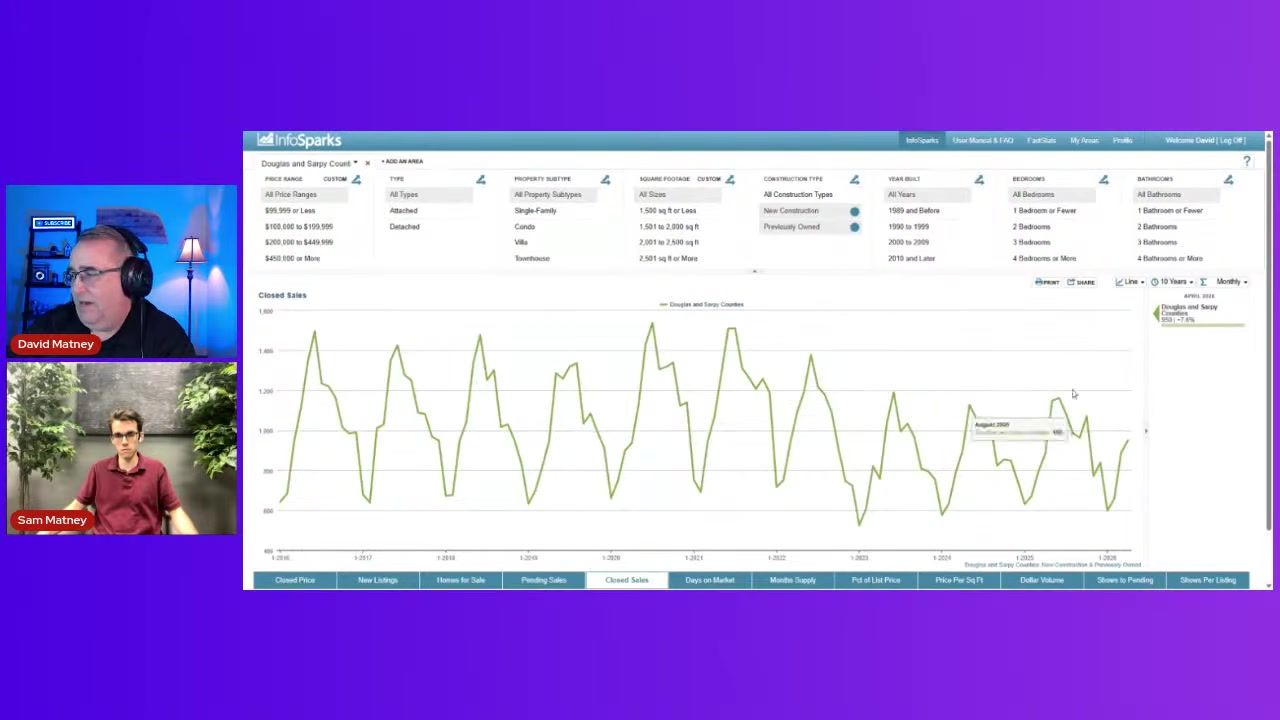
Let's bring this back home. What's happening in the Omaha market right now? I pulled the MLS data for Douglas and Sarpy County to see how we're tracking.
The April 2026 median closed sales price was down 1% year over year. Prices took a little bit of a hit last month. Now, is that any reason to panic? No. That's actually good for affordability. If prices come down a tad, more buyers can get in. And we're not talking about a crash. We're talking about a 1% dip.
When you break it down by construction type, it gets more interesting. Prices for new construction were up 3.9% year over year. Prices for previously owned homes were basically flat, down 0.1%. So new construction is still climbing while existing homes are holding steady.
Inventory is another story. Overall homes for sale were down 2.9% year over year. For new construction, inventory was down 8%. I think that's partly because D.R. Horton acquired Celebrity Homes, and that took a local builder out of the marketplace. On the existing side, the number of homes for sale was basically flat, up just 0.1%.
Closed sales were down 3.1% year over year. That's not a huge drop, but it's a drop. People are still buying homes. There's always a baseline number of sales. Any given year there's about 4 million homes sold across the United States. Even during the Great Recession, there were still sales. But fewer people are buying now than in 2021 or 2022.
Why? Interest rates. During COVID, rates were at 2.5% or 3%. Sales spiked. We had multiple offer situations. People were waiving appraisals. Prices went crazy. Then the Fed raised rates to cool things down. Sales dropped. We went from over 14,000 closed sales per year in 2021 to around 10,000 in 2024 and 2025. That's a significant drop.
But here's the thing. Even though sales are down, prices have not crashed. We had one year, 2023, where prices dipped 5.7%. But they bounced back. In 2024, prices were up 1.1%. In 2025, prices were up 1.7%. And now in 2026, we're down 1% year over year. That's not a crash. That's a normal market correction.
New Construction Trends in Douglas and Sarpy County
New construction is a big part of the Omaha market. Right now, new construction makes up about 25% of overall sales. That's a significant chunk.
Inventory for new construction tanked during the pandemic. Builders couldn't get materials. Supply chains were a mess. Then D.R. Horton came into our market in 2022, and inventory started climbing again. You can see it on the charts. New construction inventory has been trending upward since then.
But now it's plateauing a little bit. And I think it's trending downward slightly because D.R. Horton acquired Celebrity Homes. That took a local builder out of the mix. We're supposed to have another player coming in, Lennar, but I don't know much about them yet. I know they've been interviewing. I don't know when they'll start building.
Having another player in the mix is good for consumers. Competition makes everybody better. One thing I liked about Celebrity was that they offered a lot of customization. D.R. Horton is more of a production builder. They build 90,000 homes a year. They're a machine. They know what people want. They offer discounted interest rates sometimes, we've had a couple of folks get in at 4.99%. Their insurance is a little bit cheaper too because they're building to current code.
But when you're building that many homes, you're not offering as much customization. So I think Lennar coming on board will bring more options. And that's good for buyers.
I heard D.R. Horton is also moving into the Lincoln market. I don't know the Lincoln market well, but it'll be interesting to see how that shakes out. I-80 is already a sea of D.R. Horton homes. If you drive out there, it's amazing to see how fast they put up a home. When you're doing something 90,000 times a year, you get it right.
What This Means for Buyers and Sellers
If you're a buyer, here's what you need to watch. Inflation is up. Mortgage rates are elevated. Affordability is tight. But the Omaha market is still relatively stable. Prices are not crashing. Inventory is not spiking. Sales are down a bit, but not dramatically.
If you're thinking about buying, don't wait for rates to drop to 3%. That's not happening anytime soon. The Fed wants inflation around 2%. We're at 3.8%. Until inflation comes down, rates are staying elevated. So if you're ready to buy, buy. Don't try to time the market. Work with a lender who can help you understand your options. Look at different loan programs. See if a builder is offering a rate buydown. And make sure you're comfortable with the monthly payment.
If you're a seller, understand that buyers are more cautious right now. They're watching gas prices. They're watching grocery prices. They're watching mortgage rates. If you price your home aggressively, it might sit. If you price it right, it'll move. Work with an agent who knows the local market and can give you honest feedback on pricing and positioning.
And if you're relocating to Omaha, know that our market is different from the national headlines. We don't have the wild price swings you see in California or Colorado. We don't have the inventory glut you see in some markets. We're steady. We're affordable. And we're still a good place to buy a home.
One thing to keep in mind if you're relocating: insurance costs in Nebraska can be higher than you expect. We're in a high-risk state for hail and wind. An old roof can really hit you in the pocketbook. So when you're budgeting for a home, factor in insurance. And if you're buying an older home, get a good home inspection. There are things you don't know about a home until an inspector walks you through it. Electrical codes change. Plumbing codes change. Building codes change. An inspector will educate you on all of that.
FAQ
Will mortgage rates go down in 2026?
It depends on inflation. If inflation stays elevated, the Fed will keep rates higher for longer. If inflation comes down, rates could ease a bit. But don't expect rates to drop back to 3%. That was an anomaly. Historically, 6% to 7% is more normal.
Are home prices going to crash in Omaha?
No. Prices in Omaha have stayed relatively stable even as sales have dropped. We had a 1% dip in April 2026, but that's not a crash. That's a normal market correction. Omaha doesn't have the wild price swings you see in other markets.
Should I wait to buy a home until rates drop?
If you're ready to buy, buy. Don't try to time the market. Rates might drop a little bit, but they might not. And if you wait, prices could go up. Work with a lender to understand your options and make sure you're comfortable with the monthly payment.
How does inflation affect the housing market?
Inflation drives interest rates. When inflation goes up, the Fed raises rates to cool things down. Higher rates mean higher monthly payments. Higher monthly payments mean fewer buyers can afford to buy. Fewer buyers mean slower sales. That's the cycle.
What should sellers know about the current market?
Buyers are more cautious right now. They're watching inflation, gas prices, and mortgage rates. If you price your home right, it'll move. If you price it aggressively, it might sit. Work with an agent who knows the local market and can give you honest feedback.
Is new construction a good option in Omaha right now?
Yes. New construction makes up about 25% of the Omaha market. Builders like D.R. Horton offer competitive pricing and sometimes discounted interest rates. Insurance can be a little cheaper too because the home is built to current code. But you won't get as much customization as you would with a smaller local builder.
If you're thinking about buying or selling a home in Omaha, Douglas County, or Sarpy County, let's talk. I'm David Matney with Nebraska Realty. Call or text me at 402-490-6771, or visit LivinginOmaha.com. I'd be happy to walk you through what's happening in the market right now and help you figure out your next move. This is the kind of economic news that affects real decisions, and I want to make sure you have the information you need to move forward with confidence.
DAVID MATNEY
David Matney is a trusted Realtor® and local expert with over 20 years of experience in Omaha’s real estate market.