The Truth About Omaha Property Taxes

David Matney • September 22, 2024

If you're relocating to Omaha or the surrounding suburbs, the property tax system in Douglas and Sarpy County can feel like a riddle wrapped in a mystery. You buy a home in 2024, but you pay taxes for 2023, a year you didn't even live there. You close in September, but the seller gets money back at closing. You buy new construction and your taxes are shockingly low the first year, then they triple.

None of this makes sense until you understand one thing: Nebraska pays property taxes in arrears. That means 2024 taxes are paid in 2025. It's confusing even for longtime residents, and honestly, I think that's partly by design. Nebraska has high property taxes, and the arrears system makes it harder to see exactly what you're paying and when.

I'm going to walk you through how this works in Douglas County(which includes Omaha) and Sarpy County (home to Bellevue, Papillion, LaVista, Springfield, and Gretna). We'll cover how taxes are assessed, how they're prorated at closing, why your escrow account matters, and what happens when you buy new construction. By the end, you'll understand the system well enough to budget accurately and avoid surprises.

Table of Contents

How Property Taxes Work in Douglas County

Douglas County includes the city of Omaha and uses an arrears payment system. That means the taxes levied and assessed in 2024 are paid in 2025. If you're buying a home in 2024, you'll pay prorated 2023 taxes as if they were 2024 taxes. I know that sounds backwards, but stay with me.

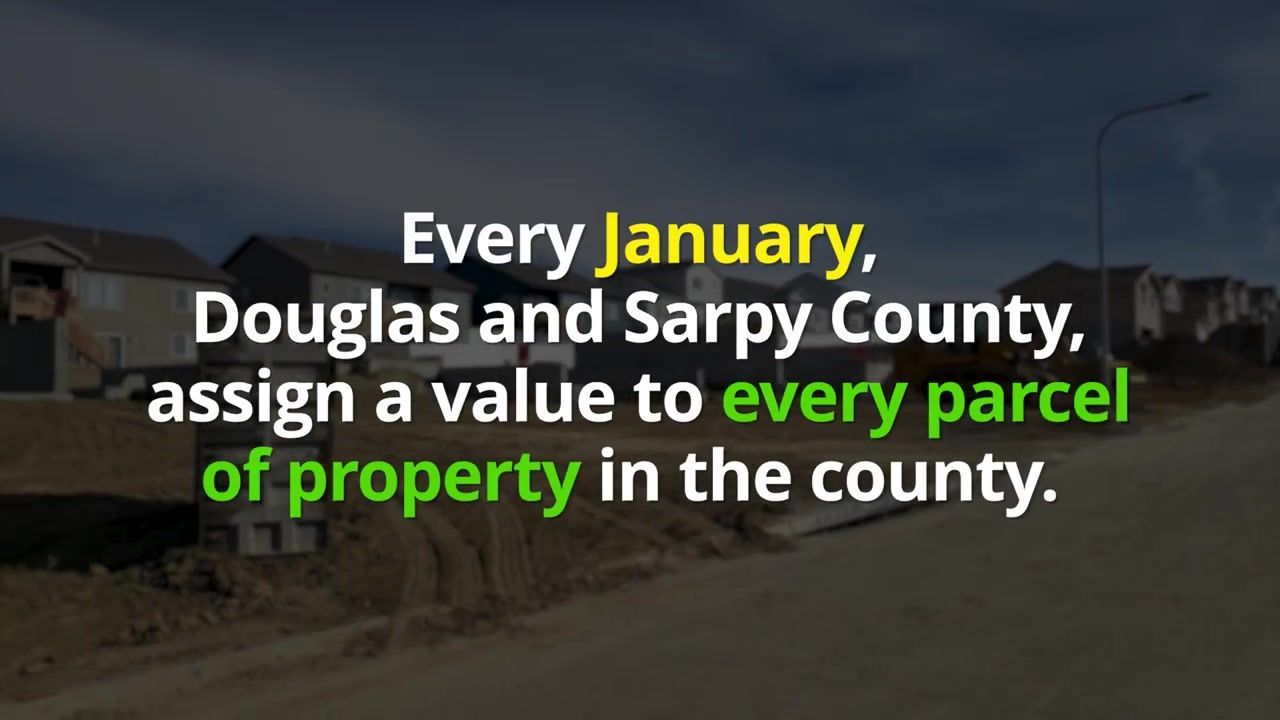
Every January 1st, the county assesses the value of every parcel of property. This is the assessed value, not the market value. The county uses this number for tax purposes. You can look up any property on dcassessor.org. Click on Assessor, then Valuation and Lookup, agree to the disclaimer, and type in an address. Let's say you search 16518 Mason Street in the Cambridge Oaks subdivision, which is in the Millard Public School District. You'll see a summary with the address, subdivision, legal description, current owners, building details (year built, bedrooms, bathrooms), and lot dimensions. In this case, the lot is 130 by 100 feet, or 0.29 acres.

The valuation section shows the assessed value: $434,500 in 2024, up from $391,800 in 2023. The county breaks this into land value and improvement value. You'll also see sales history (this home sold in August 2006 for $310,000), photos taken by the county (in this case, May 2024), and sketches with measurements. It's a wealth of information if you're buying in Douglas County.

Click on the Treasurer's Tax Report and you'll jump to the Douglas County Treasurer's site. Here you see the tax information for 2023: taxable value, tax levy, and tax amount. For this home, the 2023 taxes were $7,800.24. Remember, those 2023 taxes are paid in 2024. The county allows you to pay in two installments. The first half becomes delinquent on April 1st, 2024. The second half becomes delinquent on August 1st, 2024. In this example, the homeowner paid the first half ($3,900.12) on February 12th, 2024, and the second half on June 18th, 2024.

If you click on levy information, you'll see a breakdown of where your property taxes go. Eleven different government agencies take a portion. Over 52% goes to the local school district, in this case, Millard Public Schools. The rest is divided among the county, city, community college, natural resources district, and other entities.

Escrow Accounts and Why Your Lender Cares

When you have a mortgage, your lender requires an escrow account for taxes and insurance. Every month, you pay PITI: principal, interest, taxes, and insurance. One-twelfth of your annual tax bill and one-twelfth of your annual insurance premium go into the escrow account. When taxes or insurance come due, the lender pays them out of that account.

Why does the lender care so much? Because tax liens are senior to mortgage liens. If you don't pay your property taxes, the county can foreclose on your home, and the bank loses its collateral. Some investors even buy tax lien certificates, paying the back taxes and collecting penalties. After a certain amount of time, they can foreclose and purchase the property for the back taxes. Your lender wants to make sure that never happens, so they handle it for you.

As taxes and insurance increase over time, your monthly payment will increase slightly. The lender adjusts your escrow account annually to make sure there's enough to cover the bills.

One Drawback: High Property Taxes

Let's be honest. One of the drawbacks of moving to Nebraska is our high property taxes. The tax levy in older parts of Omaha is around 2.1%. That's the rate of taxation applied to your assessed value. If you're in a newer subdivision outside the city limits, the levy can be over 2.8%. We'll talk more about why that is in a moment.

How Property Taxes Work in Sarpy County

Sarpy County sits south of Douglas County and includes the cities of Bellevue, Papillion, LaVista, Springfield, and Gretna. The arrears payment system works exactly the same way here. You pay 2024 taxes in 2025. Taxes are paid in two installments with the same deadlines: first half due by April 1st, second half by August 1st.

You can search properties at sarpy.gov. Click on property search and you'll land on the Sarpy County Assessor's website. The layout and information are similar to Douglas County: assessed value, tax levy, payment history, and a breakdown of where your taxes go.

The big difference in Sarpy County is the tax levy in newer subdivisions. If you're buying in a newly built area outside the city limits, your tax levy will be higher, over 2.8% compared to around 2.1% in older parts of Omaha. Why? Because those new subdivisions need infrastructure: roads, sewers, water lines, schools, fire stations. The county has to pay for all of that, and the tax levy reflects those costs.

Over time, as the area matures and more homes are built, the levy can come down. But if you're an early buyer in a new development, budget for a higher tax rate.

Douglas County vs. Sarpy County: Tax Levy Differences

The arrears system is identical in both counties, but the tax levy can vary significantly depending on where you buy.

In older, established parts of Omaha (Douglas County), the tax levy is around 2.1%. The infrastructure is already in place. Roads are paved, schools are built, and the cost of maintaining those systems is spread across a larger base of homeowners.

In newer subdivisions outside the city limits, whether in Douglas or Sarpy County, the tax levy can exceed 2.8%. These areas are still building out. The county is financing new roads, utilities, and public facilities, and those costs are passed on to homeowners through a higher levy.

Here's a quick comparison:

Location Tax Levy Why
Older Omaha (Douglas County) ~2.1% Established infrastructure
Newer suburbs outside city limits (Douglas or Sarpy) ~2.8% New infrastructure costs

If you're comparing two homes with the same assessed value, the one in the newer subdivision will have a higher annual tax bill simply because of the levy difference. Make sure you factor that into your budget.

What to Expect at Closing

Now let's talk about what happens when you buy a home in 2024. You're paying 2023 taxes as if they were 2024 taxes. How does that work at closing?

Paragraph 11 of the purchase agreement in Douglas and Sarpy County addresses this. It says that all consolidated real estate taxes which become delinquent in the year of closing are considered current taxes for the purposes of the agreement. Those taxes are prorated as of the closing date.

Let's say you're buying the home at 16518 Mason Street and closing on September 3rd, 2024. The seller has already paid all of the 2023 taxes for the entire year (remember, 2023 taxes are paid in 2024). That means the seller gets a credit at closing. You, the buyer, are responsible for the taxes from September 3rd through December 31st, 2024. The title company calculates the proration and shows it on your closing statement.

You'll also need to pre-fund your escrow account. The lender wants enough money in the account to pay the insurance and property taxes when they come due. Typically, you'll pay the first year of homeowner's insurance upfront as part of your closing costs. Let's say that's $2,400. The lender will also ask for an additional three months of insurance to pre-fund the escrow account.

For taxes, since they're paid in six-month increments, the lender will require six months of taxes plus two to three months in reserve. This can add up quickly, so budget for it when you're planning your closing costs.

New Construction and Your First-Year Tax Break

One of the advantages of buying new construction is the property tax break you get in the first year. Here's how it works.

Every January 1st, the county assesses the value of every parcel. If you're buying a home that closes in 2024, but the home was still a vacant lot on January 1st, 2023, you'll pay 2023 taxes based on the vacant lot value, not the finished home. That means your first-year taxes are significantly lower.

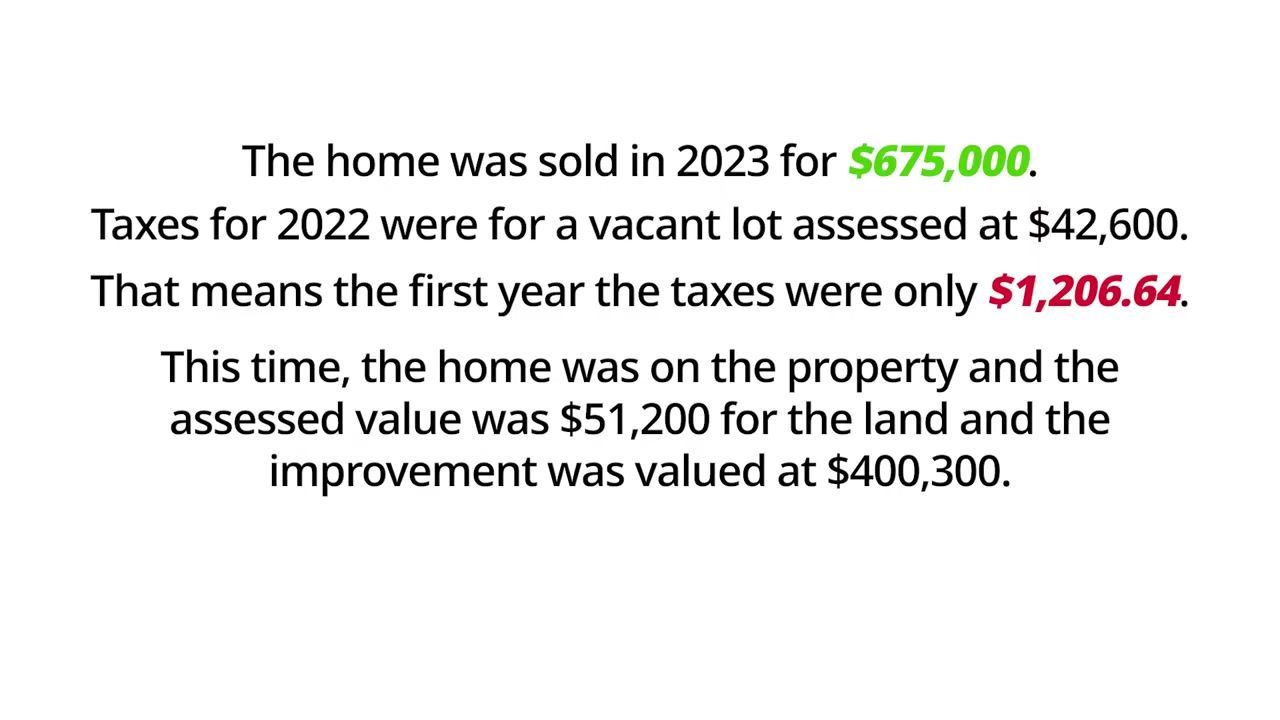
Let's look at an example. A beautiful home in the Bennington area was built in 2023 and sold for $675,000. On January 1st, 2022, it was a vacant lot assessed at $42,600. The 2022 taxes (paid in 2023) were only $1,206.64. The next year, the home was in the process of being built. On January 1st, 2023, the county reassessed the property. The land was valued at $51,200 and the improvement (the partially built home) was valued at $400,300. The 2023 taxes (paid in 2024) jumped to $12,325.54.

If you're buying new construction, understand and budget for a significant tax increase once your home is fully assessed. The county is well aware of this timing, and they will reassess your property the following year. You'll pay taxes on both the lot and the improvement.

Also, remember that newly built subdivisions have a higher tax levy because of infrastructure costs. So you're not just paying taxes on a higher assessed value, you're also paying a higher rate. Make sure your lender and your budget account for this.

Conclusion

The arrears property tax system in Douglas and Sarpy County is confusing, but once you understand the mechanics, you can plan for it. You're paying last year's taxes this year. When you buy a home, you're prorating those taxes as if they were current. Your lender will escrow your taxes and insurance to make sure they get paid on time. And if you're buying new construction, you'll get a break the first year, but your taxes will increase significantly once the home is fully assessed.

Property taxes in Nebraska are high, and the levy is even higher in newer subdivisions. But now you know how to look up a property, read the tax report, and budget for what you'll actually pay.

If you're buying or selling in Omaha, Bellevue, Papillion, Gretna, or any of the surrounding communities, I'd be happy to walk you through the numbers on a specific property. Let's schedule a free consultation and talk about your next move.

FAQ

How do I look up property taxes for a home in Douglas County?

Go to dcassessor.org, click on Assessor, then Valuation and Lookup. Agree to the disclaimer, type in the address, and you'll see the assessed value, tax levy, payment history, and a breakdown of where your taxes go. You can also click on the Treasurer's Tax Report to see detailed tax information.

What does it mean to pay property taxes in arrears?

It means you pay taxes for the prior year. In Douglas and Sarpy County, 2024 taxes are paid in 2025. When you buy a home in 2024, you pay prorated 2023 taxes as if they were 2024 taxes. The title company handles the proration at closing.

Why are property taxes higher in new subdivisions?

Newer subdivisions outside the city limits have a higher tax levy (over 2.8%) because the county needs to pay for new infrastructure: roads, sewers, water lines, schools, and public facilities. Older parts of Omaha have a levy around 2.1% because the infrastructure is already in place.

What is an escrow account and why do I need one?

An escrow account is a separate account your lender uses to pay your property taxes and homeowner's insurance. Every month, you pay one-twelfth of your annual tax bill and one-twelfth of your insurance premium into the account. When taxes or insurance come due, the lender pays them out of the escrow account. This protects the lender because tax liens are senior to mortgage liens.

Do I get a tax break when I buy new construction?

Yes, for the first year. If your home closes in 2024 but was a vacant lot on January 1st, 2023, you'll pay 2023 taxes based on the vacant lot value. The next year, the county will reassess the property and you'll pay taxes on both the lot and the finished home. Budget for a significant increase.

When are property taxes due in Douglas and Sarpy County?

Taxes are paid in two installments. The first half becomes delinquent on April 1st, and the second half becomes delinquent on August 1st. If you have a mortgage, your lender pays these out of your escrow account.

DAVID MATNEY

David Matney is a trusted Realtor® and local expert with over 20 years of experience in Omaha’s real estate market. 

OMAHA RELOCATION GUIDE

img

WATCH OMAHA VIDEOS

Aerial view of Omaha's downtown skyline with buildings and streets, labeled 'America's Anomaly'.
By David Matney • November 12, 2026
Omaha's history goes far beyond steaks and Berkshire Hathaway. Discover 10 ways this Nebraska city does the exact opposite of other U.S. cities.
A man with glasses points at a house with a stormy sky, highlighting potential issues in a real estate video.
By David Matney • November 4, 2026
From roof age and insurance to school districts and property taxes, here are 10 critical things I would never overlook when buying a home in Omaha, Nebraska.
A man with glasses looks concerned, with a map of Nebraska and the text 'NEBRASKA COLLAPSE' in bold letters.
By David Matney • October 30, 2026
Home prices haven't crashed, but affordability is eroding. Learn how we got here, why rates haven't brought prices down, and what needs to happen next in Omaha.

A man with glasses looks shocked in front of a colorful graphic of Omaha's skyline and housing market trends.
By David Matney • October 22, 2026
Omaha housing market October 2026: inventory down 6.3%, sales down 11.7%, prices up 3.1%. What buyers and sellers need to know about Douglas and Sarpy County.

A frustrated woman points at an HOA violation sign in front of a house while a concerned man looks on.
By David Matney • October 21, 2026
Can an HOA foreclose on your home? Let's break down special assessments, rising fees, and the critical questions to ask before buying.

Aerial view comparing a barren landscape to a developed area with water features and buildings.
By David Matney • October 15, 2026
From Avenue One's 200-acre Main Street to Sarpy County's $110M expressway, explore 11 major Omaha developments reshaping West Omaha, Downtown, and beyond.

The Advantages of Buying in 2026: Less Competition, More Negotiating Room — Okay, I'm, Would
By David Matney • October 14, 2026
Mortgage rates above 7%, rising prices, and higher costs make 2026 tough for Omaha buyers. But there's a room to negotiate. Here's what you need to know.
Omaha Housing Market: Is a Crash Coming or Is Everything Changing?
By David Matney • October 8, 2026
Omaha's housing ladder has stalled. First-time buyers now enter in their 30s and 40s, equity-rich sellers won't move, and multi-generational living is reshaping demand.

Three Things Every Seller Should Do Before Listing — That's, Wow, Yeah
By David Matney • October 7, 2026
Omaha agent David Matney and professional stager Susan Evans reveal the biggest staging mistakes sellers make and how to present your home to sell faster.

This allows hyperscale data center developers to build co-located power plants to help meet their massive energy needs
By David Matney • October 1, 2026
Data centers are reshaping Douglas and Sarpy Counties. Learn how proximity to these facilities affects home values and what you need to know before relocating.
Show More