Right now, Omaha homes are telling two very different stories.
Some are sitting on the market for 60 days or more. Sellers are making price cuts, getting frustrated, and wondering what they missed. At the exact same time, other Omaha homes are getting multiple offers in the first week.
That feels confusing if we only look at headlines. But when we break the market down the way it actually behaves, the pattern becomes a lot clearer.
The big takeaway is simple: this is not one single market moving in one single direction. Omaha is a collection of micro-markets. A home can be hot in one area and struggle 10 to 15 minutes away. A move-in ready resale can sell quickly while a nearby home with a few question marks gets skipped. A correctly priced house can still lose if the monthly payment does not compete with what builders are offering down the street.
If we want to understand why some Omaha homes are moving and others are not, we have to stop guessing and look at inventory, location, condition, competition, and payment all at once.
Table of Contents
- Why The Market Feels So Split
- The One Number That Matters: Months Of Inventory
- Why Headline Stats Can Be Misleading
- Which Omaha Homes Are Struggling Right Now
- Why Pricing Mistakes Hurt More In This Market
- The First Week Matters More Than Most Sellers Realize
- Which Omaha Homes Are Still Selling Fast
- What Sellers Should Do Next
- FAQ
Why The Market Feels So Split
A lot of people are trying to describe the Omaha market with one sentence. That is where the confusion starts.
The reality is that Omaha homes do not all behave the same. Price range matters. Condition matters. Neighborhood matters. Whether the home is resale or new construction matters. Even extra costs like HOA fees, insurance, or flood exposure can change buyer behavior fast.
So when someone says, “The market is slowing down,” that can be true in one slice of the market and completely false in another.
That is why some sellers feel blindsided. They hear that inventory is still low, assume demand will automatically show up, and then list a home that sits. Meanwhile, another seller in a stronger micro-market prices correctly, presents well, and gets immediate traction.
This split market is not random. It is a pattern. Once we see what is driving that pattern, the difference between a home that sells and a home that stalls becomes much easier to spot.
The One Number That Matters: Months Of Inventory
If we are trying to make sense of the market, one metric matters more than almost anything else: months of inventory.
Months of inventory tells us how long it would take to sell everything currently on the market at the current pace of sales.
- 3 months or less is generally a seller’s market
- 3 to 6 months is generally a balanced market
- 6 months or more is generally a buyer’s market
Overall, Omaha is sitting at around two months of inventory. On the surface, that sounds like a fairly strong seller’s market.
But when we isolate the existing home market, the number is even tighter, closer to 1.3 months of inventory. That difference matters a lot.
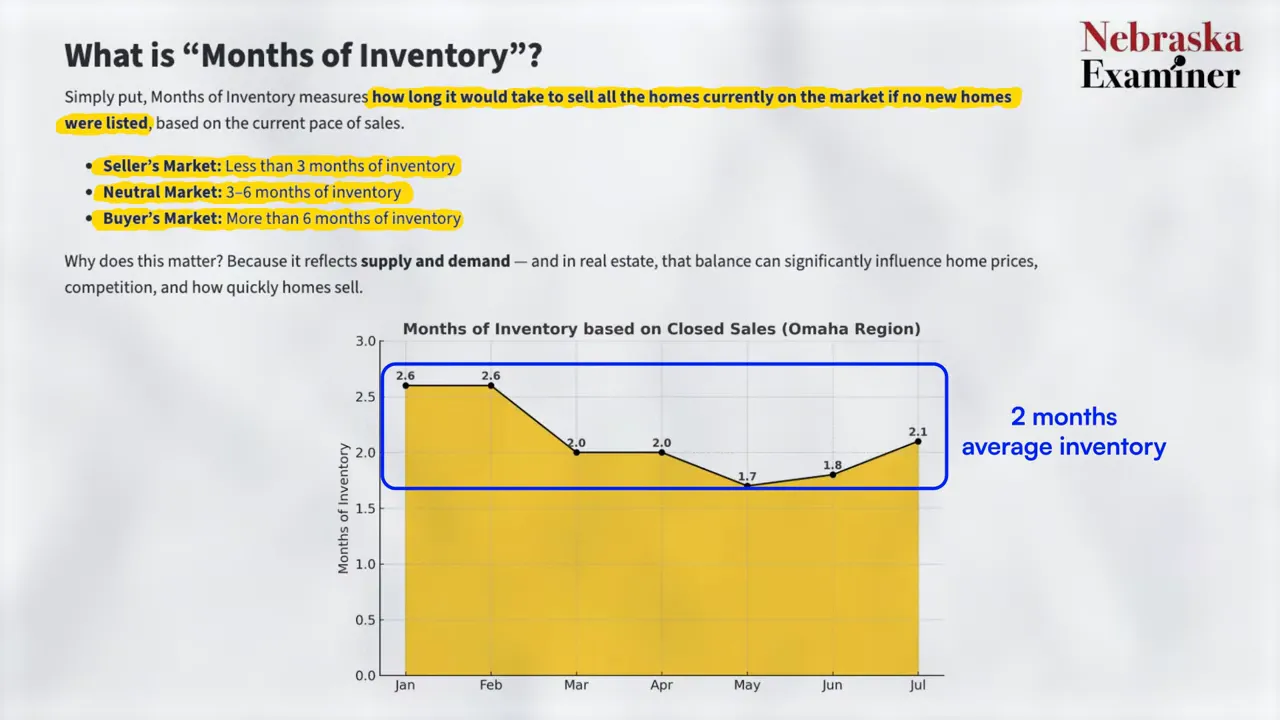
This is one of the easiest places to misread what is happening with Omaha homes. If we only look at the broad top-line number, we might assume the market is more balanced than it actually feels to someone shopping for resale homes.
And that is exactly why some buyers still feel like they have to move quickly while some sellers still feel like they are getting left behind. Both experiences can be true at the same time.
Why Headline Stats Can Be Misleading
A big reason the numbers get confusing is that they often combine new construction with existing homes.
That sounds harmless, but it changes the picture.
New construction can show up as active inventory even when it is not truly available in the same way a resale home is. Sometimes it is just a lot. Sometimes it is a home under construction. Sometimes it is already under contract and the listing is really there to market a floor plan.
So when total inventory gets reported, not all of that inventory is inventory a buyer can simply choose from right now.
The same issue shows up with days on market. New construction often includes:
- Pre-build time
- Construction time
- Marketing time
That can make market time look longer than what is happening with resale homes.
Once we separate the two, the story becomes more accurate:
- Resale homes are generally tighter and faster
- New construction tends to have more supply and longer timelines
This is one of the main reasons the market feels split. On paper it can look more balanced. In real life, it can still feel competitive, especially for the right Omaha homes in the right price range.
Which Omaha Homes Are Struggling Right Now
Not all slow-moving homes are bad homes. Usually, there is a friction point. Something is creating hesitation.
Here are the biggest reasons some Omaha homes are struggling right now.
1. Resale homes competing against builders
If builders are active in the area, sellers are not just competing with other resale listings. They are competing with brand-new homes and builder incentives.
That matters because builders can offer things many resale sellers cannot, including:
- Rate buy-downs
- Closing cost assistance
- New finishes
- Below-market interest rate programs
One example mentioned locally was D.R. Horton offering a 4.99% 30-year mortgage interest rate in the area. Whether that program changes over time is not the point. The point is that buyers are comparing more than purchase price.
They are comparing:
- Price
- Condition
- Monthly payment
That means a resale home can be “priced right” on paper and still lose if the payment is not competitive with what a builder is offering nearby.
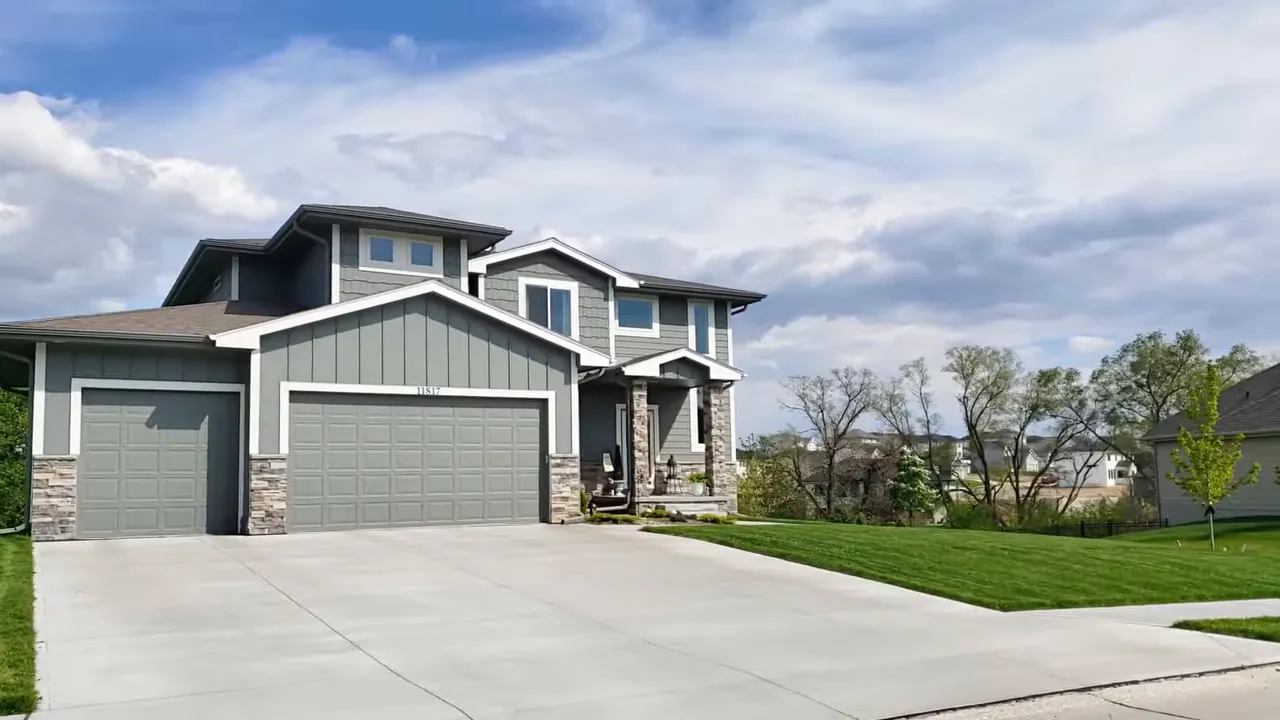
This is showing up in parts of West Omaha, where some resale homes are sitting longer while builder inventory keeps moving.
2. Higher ownership costs are scaring buyers off
Buyers are payment-focused right now. That means anything that increases the monthly cost can reduce demand.
That includes:
- Higher insurance costs
- Flood insurance concerns
- HOA fees
- Potential major maintenance expenses
One issue showing up more often is the age of the roof. That does not automatically mean the home has a problem. But buyers know insurance companies are paying attention to roof age, and they start asking the next question: What is this going to cost me?
When the answer is unclear, hesitation shows up. And when hesitation shows up, homes slow down.
This can create opportunity for buyers because uncertainty often opens the door to negotiation. For sellers, though, it is a warning sign. If buyers are unsure about a major system or future expense, they are more likely to pass than to engage.
3. The home feels overpriced, cluttered, dated, or uncertain
This is probably the biggest reason some Omaha homes are not getting traction.
Buyers have options again. And when buyers have options, they compare everything.
If a home feels even slightly off on price, many buyers do not try to negotiate first. They just move on to the next one.
The same thing happens when a home feels:
- Cluttered
- Dated
- Hard to picture living in
- Loaded with unknown repairs
Buyers are often touring five, eight, sometimes ten homes and ranking them. If a property is not landing in the top two or three, it may never get a serious second look.
And once a house sits, the market starts asking the wrong question: What’s wrong with it?
That can happen even when nothing is actually wrong.
4. Condos can move slower because the payment math is tougher
Condos have their own challenge. Buyers do not just compare the price of the condo to a house. They compare the full payment.
So if a condo comes with a significant HOA fee, buyers often stack that up against a house without one and decide the monthly cost is not worth it.
Then we add fewer comparable sales and some financing quirks that can come with condos, and it is easy to see why these can move more slowly than other Omaha homes.
Why Pricing Mistakes Hurt More in This Market
There is a mistake sellers make over and over in a market like this: they “test” the market.
That usually means listing high, hoping someone bites, and planning to reduce later if needed.
The problem is that strategy often backfires. Today’s buyers are more selective and a lot less forgiving. They are looking for homes that clearly make sense. They are not looking for “maybe” homes.
If a property misses the mark, it gets skipped.
Then comes the second mistake. The seller decides to drop the price, but only by a little. Then a little more. Then a little more after that.
Those tiny price cuts rarely create momentum. They just keep the listing sitting there while the market gets more skeptical.
If a price adjustment is needed, it has to be meaningful enough to create fresh interest. The goal is not just to lower the number. The goal is to make buyers stop, look again, and say, “Okay, now that makes sense.”
That is how momentum gets rebuilt.
The First Week Matters More Than Most Sellers Realize
There is a reason the first week on market is so important. It is usually when a listing gets the most attention and the best chance at attracting the strongest offers.
You do not get a second chance at that first wave.
If the home is priced correctly, prepared well, and positioned right from day one, that early attention can work in your favor. If not, the listing can lose momentum fast, and once momentum is gone, it gets harder to recover.
This matters even more because affordability is tighter now. Mortgage rates moving from around 6% to above 6.5% may not sound dramatic at first, but for buyers working through monthly payment limits, it changes what feels comfortable.
That does not mean buyers have disappeared. It means they are more selective about what they say yes to.
So for Omaha homes coming to market, the opening strategy matters more than ever:
- Price for today’s market, not last year’s
- Remove obvious objections before listing
- Make the home easy to understand and easy to picture living in
- Compete on payment reality, not just asking price
Which Omaha Homes Are Still Selling Fast
Even in a more selective market, some Omaha homes are still moving quickly. The pattern there is pretty consistent too.
1. Entry-level properties
Entry-level homes are still competitive. Buyers in this segment are trying to get in, and when a good property hits the market, it tends to move.
These buyers know if they hesitate too long, someone else may step in first.
2. Homes in strong areas
Location still does a lot of heavy lifting.
Some areas naturally give buyers more confidence before they even walk through the front door. When a home is in a place buyers already feel good about, it has an advantage.
That does not mean anything will sell at any price. It means strong locations continue to perform better when buyers are choosing carefully.

3. Move-in ready homes
Buyers do not want projects right now. They do not want surprise repairs. They do not want to wonder how soon they will need to replace major systems.
That is why clean, prepared, move-in ready Omaha homes keep standing out.
Presentation matters. Condition matters. How a home feels matters.
4. Homes priced for today
This is the real story behind the homes selling fastest.
The winners are not necessarily the cheapest homes. They are the homes priced for today’s market, not last year’s market, not the peak, and not the seller’s ideal number.
When a home feels aligned with current conditions, buyers respond. When it does not, they keep moving.
The market is not broken. It is just more selective and much less forgiving.
What Sellers Should Do Next
If we are trying to sell in this kind of market, the goal is not simply to get listed. The goal is to launch correctly.
That means being honest about what the home is competing against and realistic about how buyers are making decisions.
A good starting checklist looks like this:
- Know your true competition. That includes nearby resale listings and builder inventory.
- Think in terms of payment. Buyers are not only looking at price. They are calculating the full monthly cost.
- Handle uncertainty early. Roof age, HVAC questions, insurance concerns, and obvious repairs should not be left vague.
- Prepare the home to rank high. Buyers are comparing multiple homes quickly. If yours is not memorable in a good way, it gets skipped.
- Price with purpose. A strong opening price creates momentum. A weak opening price often creates a long list of reductions.
That is really what separates the two groups of Omaha homes right now. The homes that sell quickly tend to remove friction. The homes that sit usually add it.
And that is also where opportunity lives. When we understand which homes are slowing down and why, we can make smarter decisions, whether we are selling, buying, or trying to time a move inside the Omaha area.
If you want to know whether your Omaha home will sell fast, call or text **402-490-6771** today. I’ll help you compare your home to the real competition and map out the best next step—quickly.
FAQ
Why are some Omaha homes sitting on the market?
Most of the time, it comes down to a handful of issues: price, condition, competition from new construction, or uncertainty around costs like roofs, insurance, flood exposure, or HOA fees. In a more selective market, buyers often skip homes that feel even a little off.
Is Omaha still a seller’s market?
Overall, Omaha is still around two months of inventory, which points to a seller’s market. When we isolate existing homes, inventory is even tighter at about 1.3 months. But that does not mean every segment behaves the same. Some Omaha homes are still very competitive, while others are moving slowly.
Why does new construction change the resale market so much?
Builders can offer incentives that most resale sellers cannot, including rate buy-downs, closing cost help, and brand-new finishes. Buyers are comparing monthly payment, not just list price, so a resale home can struggle even if the asking price seems reasonable.
What types of Omaha homes are selling the fastest?
The fastest-moving Omaha homes tend to be entry-level properties, homes in strong locations, move-in ready homes, and homes priced correctly for current market conditions.
Do small price reductions help a home sell?
Usually not. Small, repeated reductions often keep a home sitting without creating new urgency. If a price adjustment is needed, it typically needs to be meaningful enough to generate fresh interest and restore momentum.
Why do condos often move slower than houses?
Many buyers focus heavily on monthly payment. When a condo has an HOA fee, they compare that combined payment against a house without one. Add fewer comparable sales and financing quirks, and condos can take longer to sell than other Omaha homes.
When we step back and look at the full picture, the story becomes much clearer. The issue is not that Omaha homes are suddenly impossible to sell. It is that the market is sorting more aggressively than it used to.
The homes that check the right boxes still move. The ones that create hesitation do not get the benefit of the doubt.
That is the difference.
READ MORE: Omaha Homebuying Mistakes: 6 Costly Red Flags to Avoid Before You Buy a House